
On 10 March 2026, the Regeneron Science Talent Search, the oldest science and mathematics competition for high school seniors in the United States, gave its 250,000 dollar first prize to Connor Hill, a 17-year-old from State College, Pennsylvania.
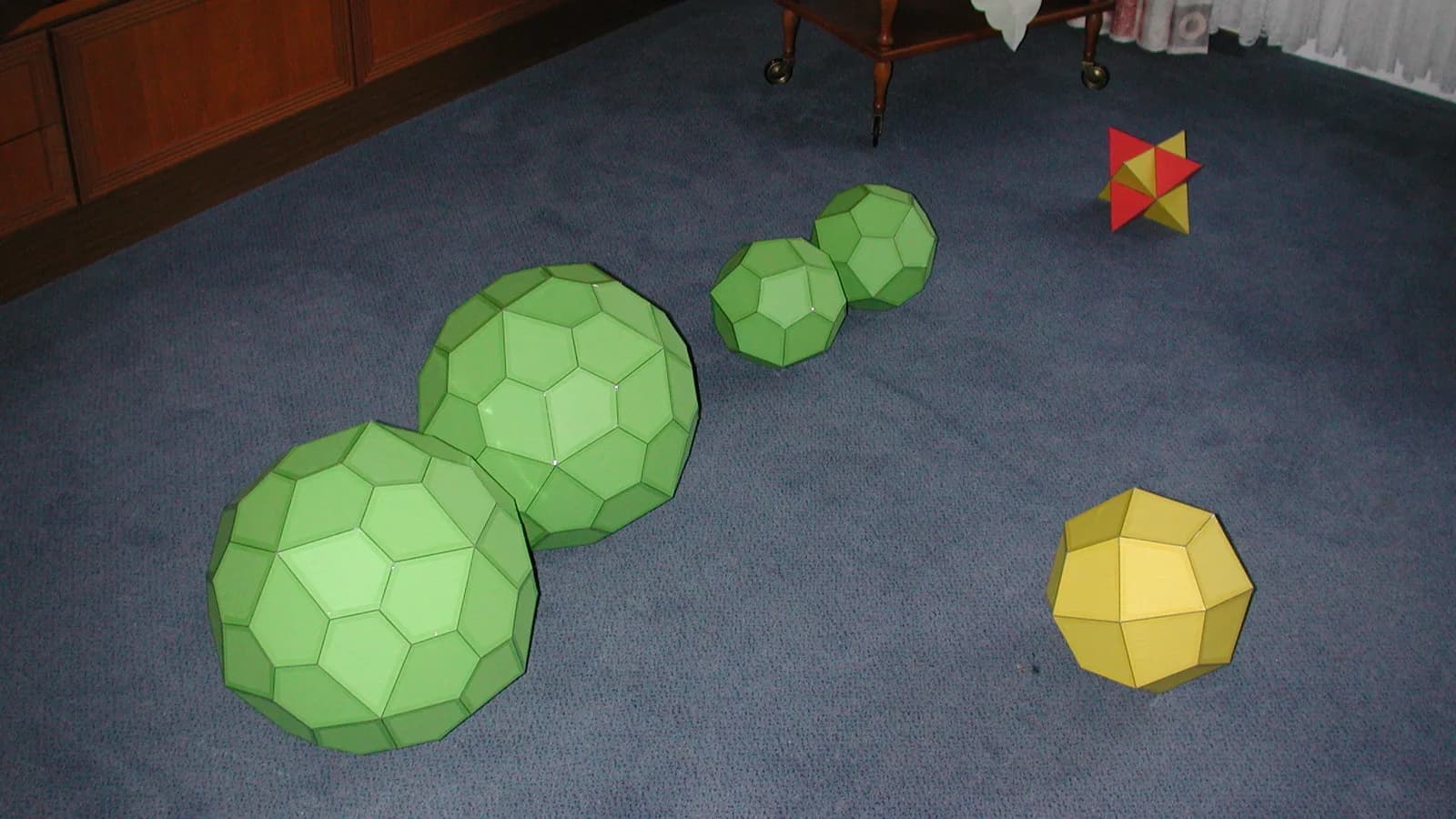
His project sounds simple and is not: he finished a list that mathematicians had been building for about a hundred years. A polyhedron is a solid shape with flat faces and straight edges, like dice from a board game. A noble polyhedron is a rare, extra-balanced kind where every face is the same as every other face and every corner is the same as every other corner. Mathematicians knew two infinite families of them plus a pile of one-off examples, and nobody knew whether the pile was complete.
Unfinished lists make mathematicians uncomfortable for a practical reason. If you do not know the list is complete, you never know whether the next strange example is still out there waiting, and every result built on the list inherits the doubt.
The missing piece was not more patience. It was a way to search everything. Checking shapes by hand had taken a century to get this far. Hill combined two crafts: enough mathematics to define exactly what counts as a noble polyhedron, and enough programming to make a computer walk through every possible case. He proved the full answer: two infinite families, and exactly 146 isolated examples. The other top winners followed the same pattern in different fields. Edward Kang, 17, trained AI models on eye images to help screen for autism and ADHD, and Iris Shen, 17, tested whether a clam with a natural blood cancer could stand in for humans in early drug research. More than 2,600 students entered.
The part worth copying is how a result like this earns trust, because a claim of 'we found them all' is easy to say and hard to prove.
A proof is a step-by-step argument that other people can check line by line, covering every possible case rather than just the ones tried so far. A program can help by doing the exhaustive searching, but the program itself becomes part of the argument, so its logic has to be checked too. Competition judges, working scientists and mathematicians, reviewed Hill's work in depth to award the prize. The next rung is publication, where journal reviewers whose job is to break the argument get their turn. Each rung climbed makes 'we found them all' harder to doubt.
Published for others to build on
Still aheadJournal reviewers try to break the argument before it is printed.
Experts check the work
Happening nowScience Talent Search judges reviewed the project in depth.
A proof covers every case
ReachedA step-by-step argument, with the search program as part of it.
A program searches everything
ReachedCode walked through cases no hand count could reach.
Examples pile up
ReachedAbout a century of collectors found the known noble polyhedra.
The same ladder applies to any big claim of completeness, not just shapes.
Tradeoffs
- A computer search can cover every case, but it is only as good as the definition typed into it.
- The prize celebrates one name, but the finished list rests on a century of earlier collectors.
- Contest judging is real expert review, but journal review by other mathematicians is the stronger test still ahead.
Try this
Take a collection you know well, like chess openings or football formations. Write one sentence defining exactly what belongs in it, then test your definition against a tricky edge case and see if it holds.