
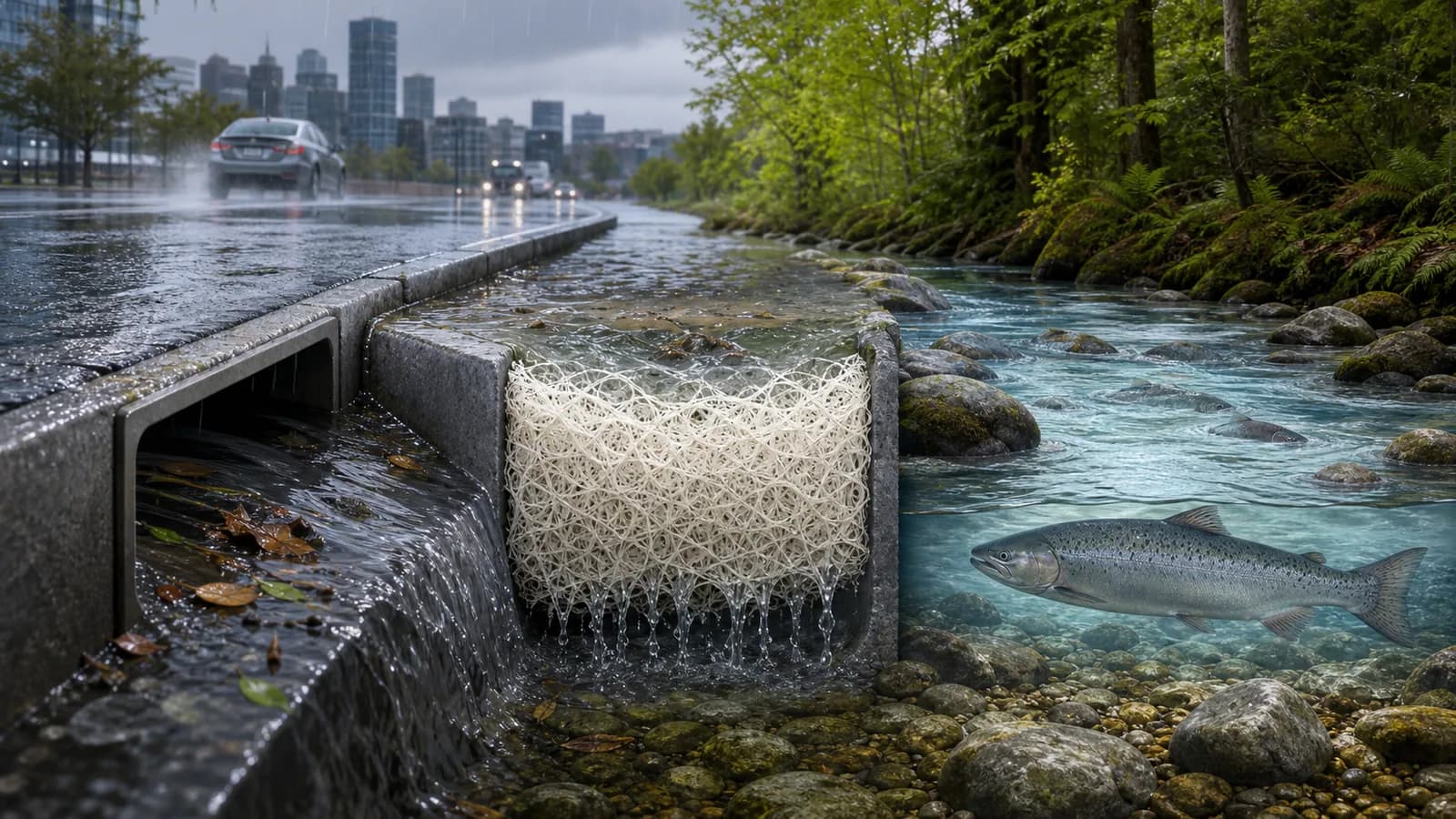
When rain hits a busy road, it picks up more than dust.
Tyres contain a chemical called 6PPD that helps protect rubber from damage. As tyres wear, particles collect on the road. 6PPD can react with ozone and form 6PPD-quinone, a pollutant linked to the deaths of coho salmon. Rain can wash it from streets into nearby waterways.
Lakshmi Agrawal, an 18-year-old student from Bellevue, Washington, wanted to catch that pollution before it reached the stream.
Her answer was a hydrosponge made with nanocellulose, citric acid and aluminium. The material is designed to sit in the path of stormwater and remove 6PPD and 6PPD-quinone from the water.
In May, the project earned Agrawal a $75,000 Regeneron Young Scientist Award at ISEF 2026.
Cleaning a polluted river after chemicals have spread is difficult. Agrawal’s project moves the intervention closer to the road, where runoff is still concentrated and can be directed through drains or treatment systems.
The choice of material is part of the idea. Nanocellulose can be made from plant matter, and Agrawal described her sponge as low-cost and biodegradable. A practical filter would need to remove enough pollutant, allow water to keep flowing and remain effective outside a controlled experiment.
Her ISEF entry tested the chemistry of that approach. It also brought together environmental science and material design: understand the pollutant, then build something that can capture it.
ISEF’s judges recognised the research at one of the world’s most competitive school science events. Agrawal had also presented the work at scientific conferences and was named a top 300 scholar in the 2026 Regeneron Science Talent Search.
The next questions are practical. How long does the sponge last in a drain? What happens when it is full? Can it be manufactured and replaced at the scale a city would need? Does it perform as well across different water conditions?
Those questions do not weaken the result. They mark the distance between a strong experiment and public infrastructure.
Agrawal’s success came from working on that first part properly: a specific pollutant, a material built for the job and evidence strong enough to stand in front of expert judges.
Tradeoffs
- Catching pollution near the road may be easier than cleaning a river later, but a city-scale system needs maintenance and safe disposal.
- Biodegradable materials may reduce waste, but field performance still has to match the controlled experiment.
Try this
If the sponge moved from a science fair to a city drain, which result would you want engineers to test first?