
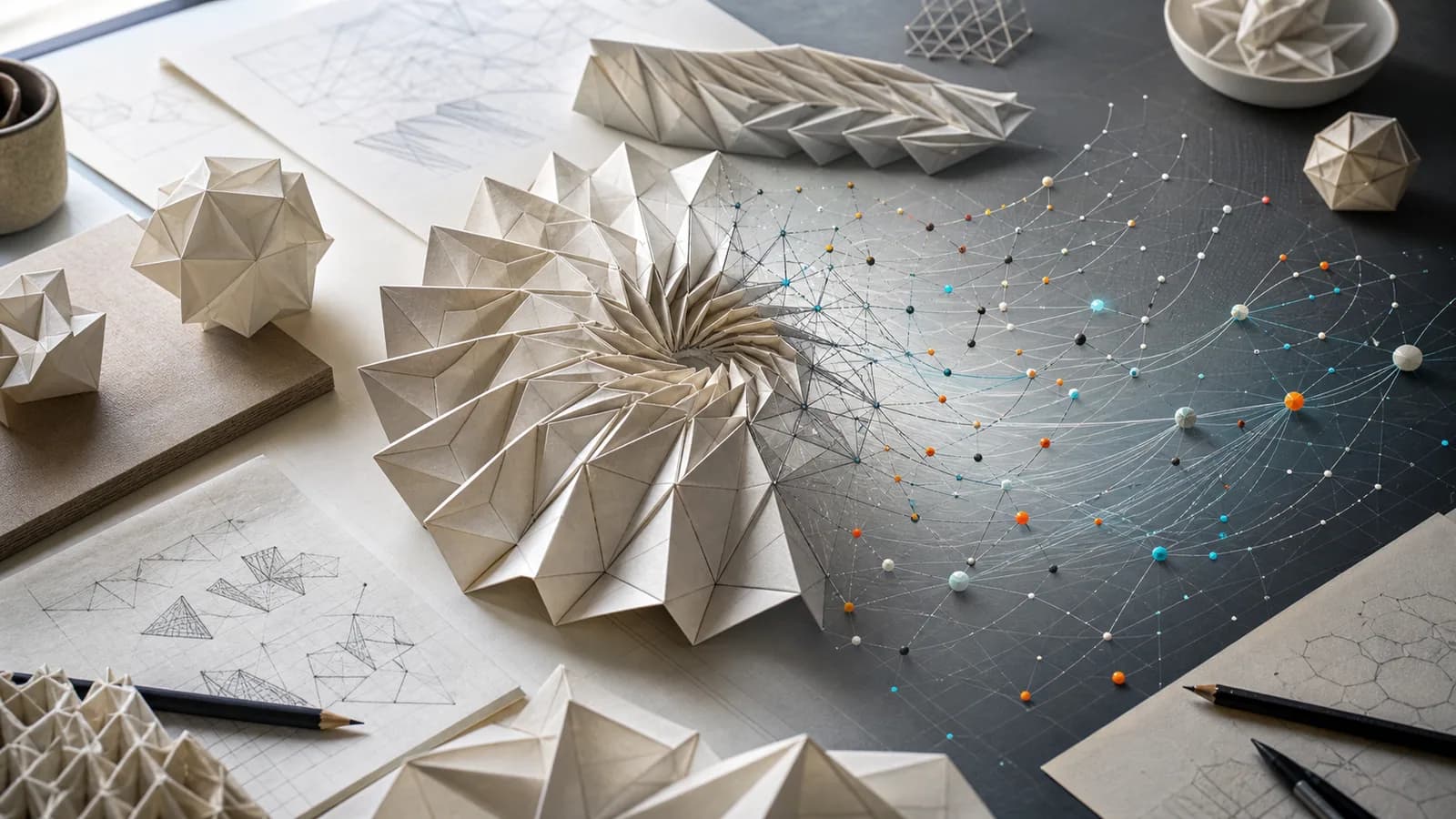
In May, Hikaru Kuribayashi arrived in Phoenix from Sapporo, Japan, carrying a problem hidden inside folded paper.
An origami model can move through many shapes before it becomes the finished object. Mechanical linkages behave in a similar way: rigid pieces turn around joints, and one movement changes what the rest of the structure can do. Engineers need to know all the positions a design might take, especially when the mechanism will be difficult to reach after it is built.
Kuribayashi, 17, wrote software to explore those possibilities. At the 2026 Regeneron International Science and Engineering Fair, judges awarded him the $100,000 George D. Yancopoulos Innovator Award, the competition’s top prize.
The project sounds playful until the same geometry appears in a solar panel unfolding on a satellite or a medical device changing shape inside the body. A missed movement can mean a jammed mechanism or an unexpected failure.
Traditional methods can follow a mechanism as it moves from one nearby position to the next. The hard part is finding a completely different route that sits elsewhere in the design’s range of movement.
Kuribayashi approached the problem using Markov chain Monte Carlo, a statistical method normally used to sample large sets of possibilities. Instead of walking through every fold in order, the program searches more widely across the shapes a mechanism can take.
Regeneron and the Society for Science said the software could help engineers design more efficient systems, including deployable structures and robots.
The ISEF award is a major result. More than 1,700 finalists from around 60 countries, regions and territories took part in the 2026 fair, after qualifying through earlier competitions.
It does not mean every engineering use has already been tested. Kuribayashi’s work is a research method, not a finished spacecraft component. Its value will grow if other researchers can reproduce the results and use the software on difficult designs of their own.
For now, the story is striking enough: a teenager followed a question from folded paper into physics, computation and a tool that professional engineers may be able to use.
Tradeoffs
- A wider simulation can reveal movement paths older methods miss, but its results still need checking against physical mechanisms.
- A major competition prize brings attention to the method, but does not establish every proposed engineering use.
Try this
Where else might a familiar object, such as folded paper, reveal a serious engineering question?