
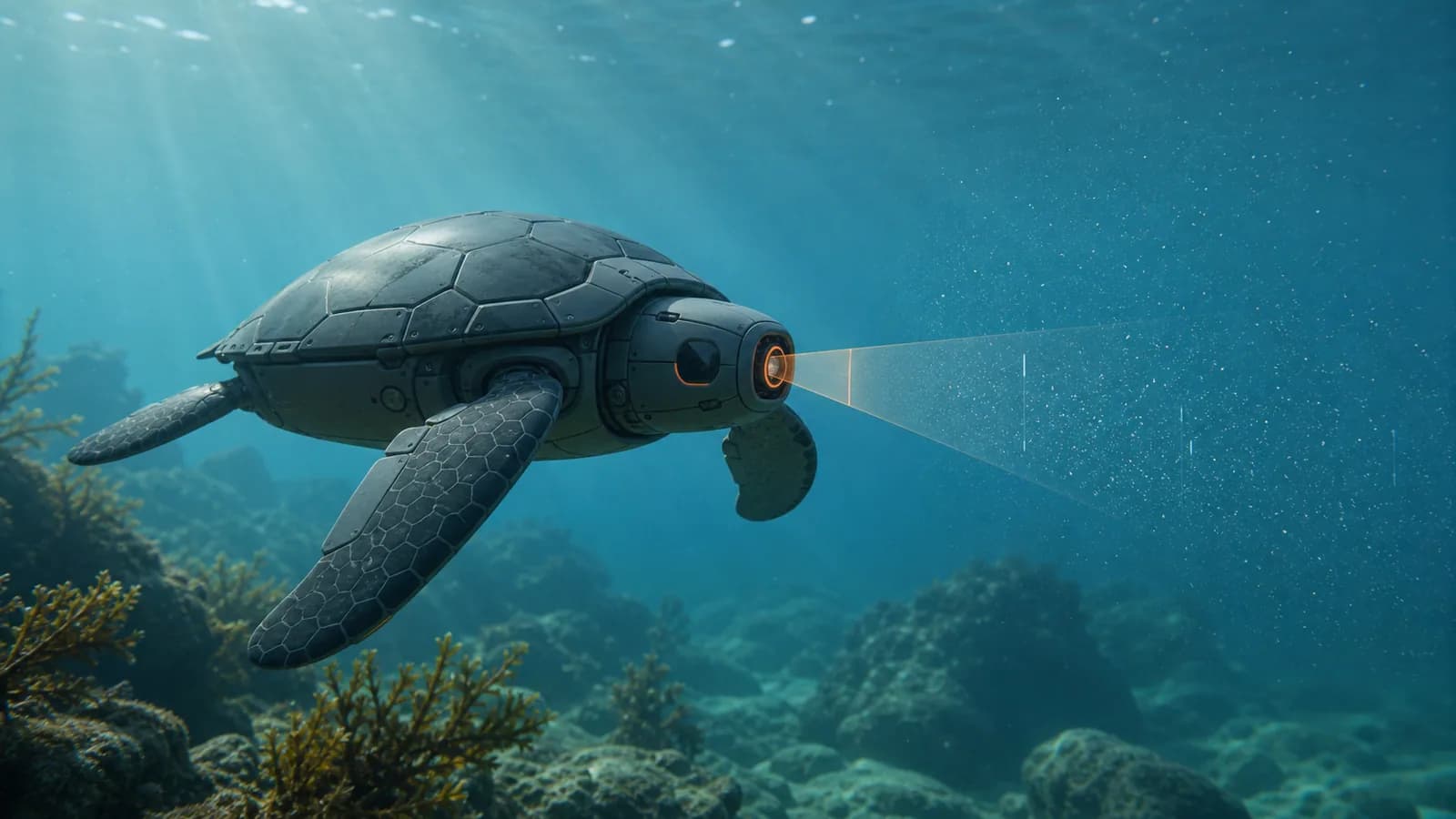
Evan Budz built a sea turtle with a laboratory on board.
The 17-year-old from Burlington, Ontario, wanted to detect microplastics while they were still in the water. These fragments can be too small to see easily, and researchers often collect samples before taking them back to a lab for analysis.
Budz’s answer was an autonomous bionic sea turtle carrying a holographic imaging system. Software analyses the images and looks for particles that match microplastics.
At the 2026 Regeneron International Science and Engineering Fair, the project won the Gordon E. Moore Award for Positive Outcomes for Future Generations.
The project joins several difficult systems. The robot has to move through water, keep its imaging equipment stable, collect usable data and distinguish plastic from other tiny material floating nearby.
The turtle shape is not only a visual hook. Bio-inspired robots can move in ways suited to the environment they are studying. Whether this design works reliably in waves, currents and cloudy water is a question for field testing.
The detection method also needs careful measurement. A useful system must find a high proportion of the plastic present without labelling too many natural particles as plastic.
Budz qualified for ISEF through Youth Science Canada and competed among more than 1,700 finalists from around 60 countries, regions and territories.
The award recognises the complete project: robot, imaging and analysis working toward an environmental problem. It does not establish that the turtle is ready to survey oceans at scale.
That next stage would need trials in different waterways, comparison with laboratory methods and a clear plan for how scientists use the resulting data.
The current result is already substantial. Budz did not stop at detecting microplastics in a prepared sample. He designed a machine that tries to take the detection work into the environment itself.
Tradeoffs
- Detecting particles in place can speed up a survey, but moving water makes imaging and classification harder.
- A bio-inspired shape may suit the environment, while reliability matters more than resemblance.
Try this
Which comparison would convince you that the turtle’s readings are as trustworthy as a laboratory test?