
Every kilogram sent into orbit has a cost. So does every watt a satellite uses after it gets there.
Landon Kummer, Tobin Palmer and Brandon Kirbyson, students from California, looked at the machinery used to point and steer small satellites. Conventional systems can rely on several motors and mechanical assemblies working across different axes.
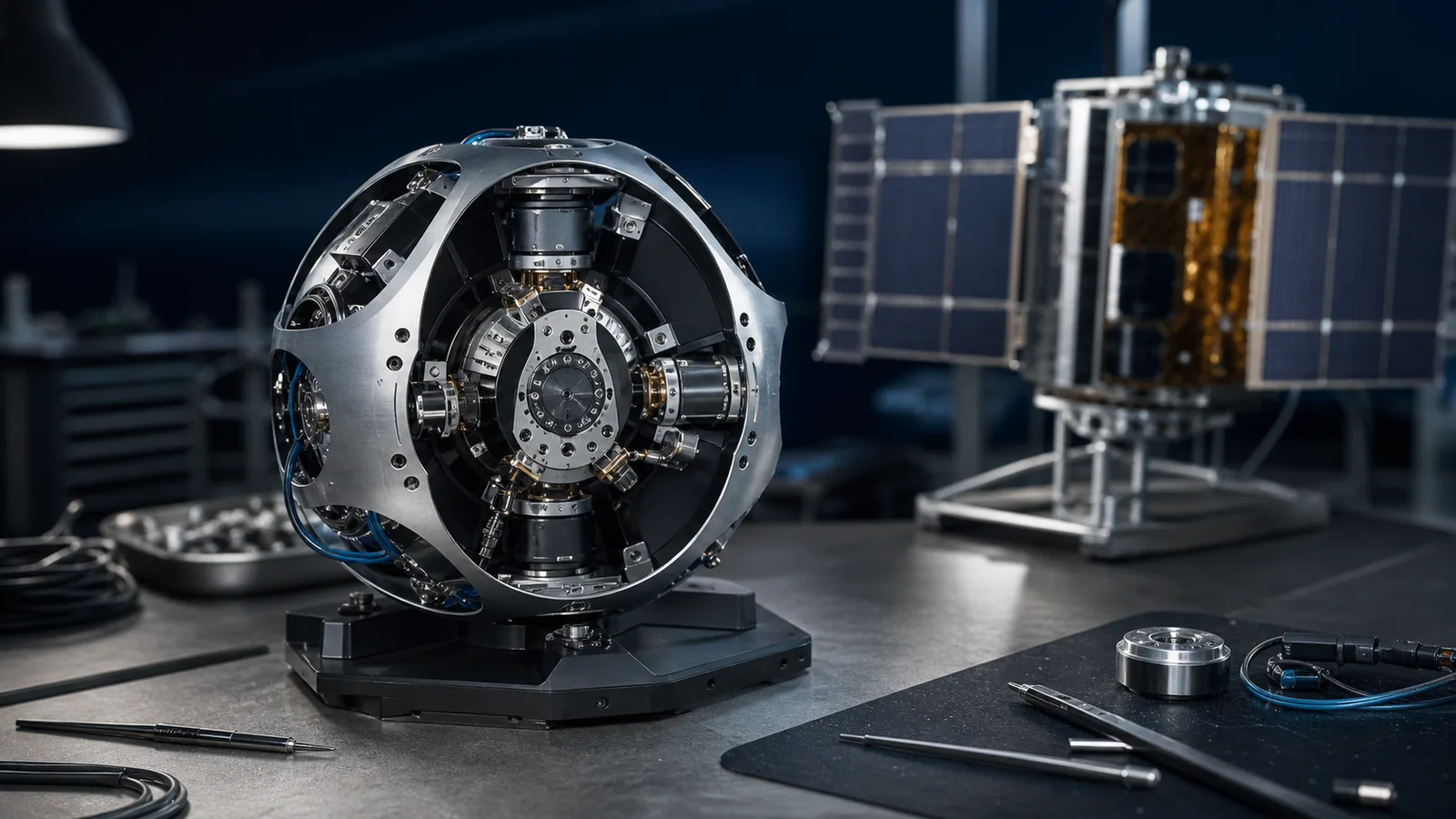
Their team, Aphelion, tried to combine those movements inside one spherical motor.
The students designed the mechanism, built a preliminary prototype and developed the control software. In April, judges at the Conrad Challenge named Aphelion a 2026 Pete Conrad Scholar team in Aerospace and Aviation, the competition’s highest category honour.
Aphelion’s idea is to replace a heavier gimballed arrangement with a single actuator capable of movement across several axes. The Conrad Challenge’s award page reports that the preliminary prototype used less mass, occupied less volume and required less power than the technologies the team chose for comparison.
Those are promising prototype measurements. They are also company and competition claims based on an early build, not results from a satellite operating in orbit.
The team divided the work. Kummer led business operations and control software. Kirbyson developed the mechanical design and computer-aided models. Palmer worked on electronics, embedded systems and outreach.
That mix matters because the product is not only a motor. It needs software to control its movement, electronics to supply power and a route into an industry where reliability is tested hard.
More than 1,750 projects from over 70 countries entered the 2025–2026 Conrad Challenge. The finalist teams presented at Space Center Houston to 30 expert judges.
Winning gives Aphelion recognition, feedback and access to support around intellectual property and further development. The team’s own roadmap places customer discovery and market validation before a future first deployment.
That sequence is honest. A prototype can show that a design deserves another test. Spaceflight requires much more: vibration testing, thermal performance, long-term reliability and a customer willing to put the component on a mission.
Aphelion has not reached orbit. Its reported success is that three students found a costly engineering constraint, built a physical response and produced enough evidence to win one of the world’s better-known student innovation competitions.
Tradeoffs
- Combining several movements in one actuator can save mass and power, but concentrates more responsibility in one component.
- Prototype measurements support another test, not a promise of performance in orbit.
Try this
Which test would tell a satellite customer more: another bench demonstration, a vibration test or a first flight?